

By James Picerno | The Milwaukee Company
U.S. recession risk remains low, according to TMC Research’s business‑cycle indicator
Consumer spending and hiring have cooled, but have not broadly deteriorated
The hiring slowdown likely reflects labor‑force constraints, not rising business‑cycle risk
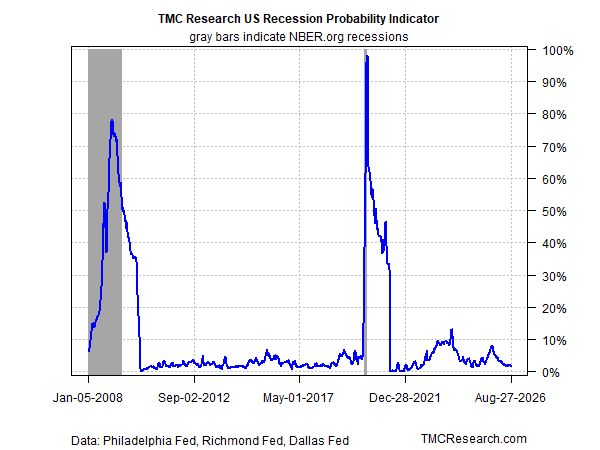
Despite a year packed with geopolitical flare‑ups, market tremors, and policy whiplash, a surprising constant has endured: the U.S. economy keeps powering forward. That’s not to say all is well. Several recent developments could turn problematic in the months ahead. Even so, TMC Research’s Recession Probability Indicator (RPI) continues to show low odds that an NBER‑defined contraction is imminent — let alone already underway.
Today’s update echoes RPI’s low‑risk estimates in previous reports this year — in early March (just a few days into the war with Iran) and in mid‑June. With the benefit of hindsight, it’s clear that both estimates were spot‑on. That’s no assurance that today’s low‑risk reading will prevail, but the data suggest that a growth bias continued through late‑August. (RPI aggregates and processes data from three business‑cycle indicators published by regional Fed banks — see here for details.)
Recent economic news has been mixed, highlighting areas to monitor in the months ahead for possible warning signs, including rising Treasury yields, which reflects a mix of concerns, including inflation and the unchecked rise in US government debt.
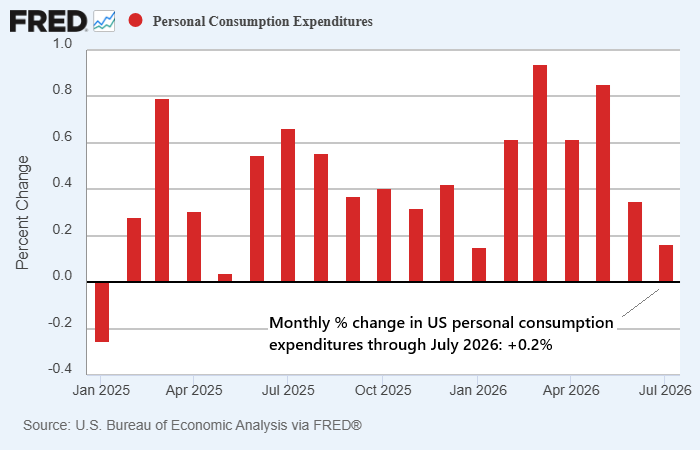
The recent slowdown in consumer spending also deserves close attention. After accelerating earlier in the year, month‑to‑month growth in personal consumption expenditures downshifted in June and July, rising 0.2% last month — the slowest since January. The softer growth in spending has eased to the lower end of the range for the past year, which suggests that if the deceleration continues it could mark a warning sign for the consumer sector.
Hiring at U.S. companies has also slowed in recent months. Private nonfarm payrolls rose by a modest 30,000 in July, matching the gain in June. The increase marks the slowest pace of job creation since February. Today’s estimate for private payrolls in August via ADP suggests that hiring remained sluggish through last month.
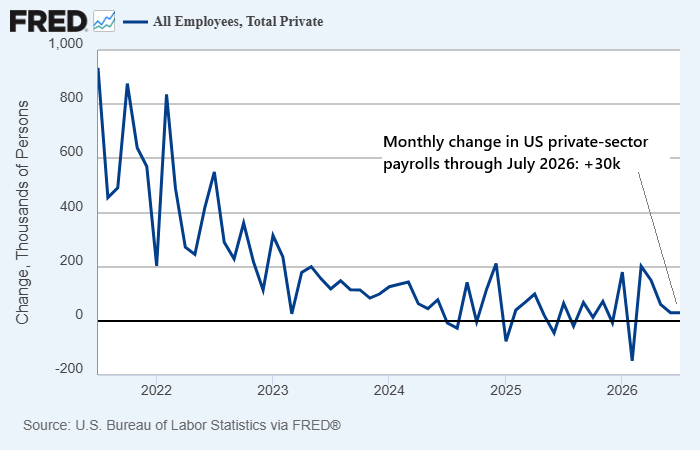
Economists are split on what the recent slowdown in payroll growth actually signals. One camp sees softer job gains as a possible warning for the business cycle, noting that weaker monthly payrolls have historically preceded downturns. But a growing body of research points to a different explanation: labor‑force growth has declined due to sharply lower immigration and an aging population, pushing the breakeven employment growth rate — the number of jobs needed to keep unemployment steady — down, closer to zero. In this view, slower payrolls aren’t necessarily evidence of weakening labor demand but rather a reflection of demographic and immigration‑driven constraints on labor supply.
The bottom line: recession risk remains low, but the margin for error may be narrowing. The next few months won’t just test the expansion — they’ll reveal whether the economy’s resilience still has room to run. If and when economic risks begin to rise, early signs of the shift could potentially show up in the Recession Probability Indicator. For now, at least, business‑cycle risk appears low.
