

By James Picerno | The Milwaukee Company
Risk tolerance shifts with markets and emotions
Static portfolios miss these swings
Rules and periodic reviews keep investment decisions aligned with long‑term goals
Recent research is overturning the entrenched assumption that risk tolerance is relatively stable. New evidence shows it moves far more than most investors realize, which has several implications.
For starters, asset allocation should be dynamic to some degree rather than static. Regular re‑evaluation of risk profiles is also prudent.
Understanding your true risk tolerance is essential because it determines whether you can stay invested through the market’s inevitable ups and downs. When risk tolerance is misjudged, emotions may play an oversized role, which can lead to panic selling, performance chasing, and decisions that undermine long‑term results.
Getting this right is crucial because it creates the foundation for a portfolio you can stick with, no matter what the market throws your way.
The Fluidity of Risk
A growing body of research highlights that risk tolerance fluctuates and changes with market conditions, stress levels, recent performance, and even how portfolio and risk questions are presented. The key takeaway: Investors don’t have a single, fixed appetite for risk. They cycle through different levels of comfort and discomfort depending on what’s happening around them.
If risk tolerance moves with the market, then the moments when investors feel most confident often coincide with periods when risk is highest—and vice versa. This creates a behavioral trap: taking on too much risk after strong returns and pulling back too sharply after losses.
The research suggests that managing risk isn’t just about asset allocation; it’s also about understanding how emotions, context, and market cycles shape decision‑making. For investors, the challenge is learning to recognize these shifts and building a process that keeps short‑term feelings from derailing long‑term goals.
Data‑Driven Shifts
A recent study highlights how investor comfort with risk can fluctuate as market conditions shift. Fewer than one in six US adults (16%) in 2024 said they were willing to take financial risks, down from 20% in 2021, according to the FINRA Investor Education Foundation’s 2025 National Financial Capability Study. The study also notes that only 12% of adults were relatively tolerant of risk in 2009, soon after the financial crash. By 2015, after the market had rallied for several years, that share rose to 21%.
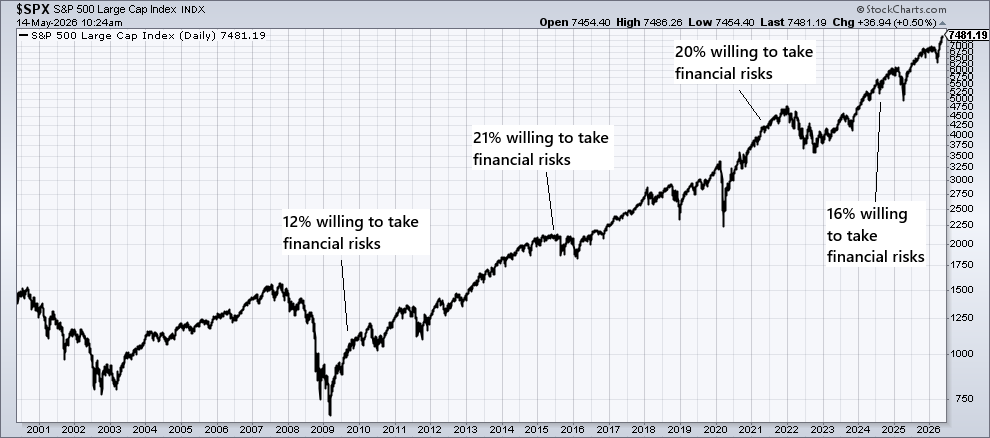
Another study found that risk preferences are dynamic and influenced by how choices are framed for 401(k) investment accounts. The authors of the 2024 research paper report that when you strip away participation barriers (such as confusing plan menus, default options, or the effort required to rebalance), more than 90% of investors would choose to hold stocks.
In contrast, “investors in the control groups who defaulted into a money market fund (or hired under an opt‑in regime) progressively increase their equity share away from their zero‑stock default,” the researchers found. “The fact that most investors move away from the default option when it is a safe asset but stay invested in the default when it is equity suggests that, absent participation frictions, these investors prefer holding risky assets.”
Practical Takeaways
In other words, the portfolios people want may be very different from the portfolios they actually end up with. If you prefer that your portfolio aligns with your real goals and risk preferences, you must actively overcome the frictions that push you toward inaction or misguided choices. Default options, old allocations, and “set‑and‑forget” choices can quietly steer you into a portfolio that doesn’t match your intentions.
Another line of analysis demonstrates that risk profiling should not rely on a one‑time questionnaire, but instead should be a continuous behavioral assessment. The paper advises: “Our findings indicate a better performance through financial returns for investors who answered behavioral finance questions and a higher retention for that group of investors with their financial advisor(s).” Risk, the author writes, “is never constant because it is shaped by both internal and external factors.”
For investors, the first step is recognizing that fluctuating risk tolerance is normal. Feeling more cautious after a market decline doesn’t mean you’ve suddenly become a conservative investor. These views may be emotional responses to recent experience and not reflect durable shifts in your financial identity.
Building guardrails can prevent temporary feelings from driving permanent decisions. This can take several forms, including:
Defining rebalancing rules in advance
Regularly reviewing investment strategy
Assessing whether discomfort reflects a true change in goals or simply a reaction to market noise.
Financial advisors can play a critical role in this process. By helping clients distinguish between emotional shifts and structural changes, advisors can prevent the most damaging behavioral mistakes.
Markets, emotions, and life circumstances change. A resilient investment plan acknowledges this reality and builds in rules to keep short‑term feelings from overwhelming long‑term objectives.
