

By James Picerno | The Milwaukee Company
Behavioral biases follow demographic patterns rather than appearing randomly
Overconfidence and herding are among the most influential drivers of suboptimal investor behavior
Financial habits formed early in life can leave lasting psychological imprints that shape risk perception well into adulthood
Behavioral risk has been on the financial industry’s radar for decades, but ongoing empirical research continues to refine our understanding of how these biases emerge, who is most susceptible, and why they matter for investors.
A recently published paper in Journal of Risk and Financial Management conducted a systematic review of nearly five dozen studies (published during 2010–2025) and finds that behavioral biases aren’t random or evenly distributed. Instead, they follow clear demographic patterns shaped by age, gender, financial literacy, income, and experience.
It’s not unlike analyzing health risks—such as heart disease or high blood pressure—which are shaped by age, diet, and lifestyle. Similarly, financial “blind spots” tend to follow predictable patterns based on who you are, how much market experience you have, and the early financial habits and security you grew up with.
If you were raised in a household where money was tight or financial hardship was constant, you may be far more likely to carry a strong loss‑aversion bias into adulthood. Even when you have plenty of savings, the instinct to protect capital at all costs can sometimes keep you from taking reasonable risks needed for long‑term growth.
The paper’s efforts to synthesize evidence from several dozen empirical studies don’t just restate the behavioral‑risk challenge—they sharpen it. By pooling results across multiple countries, methodologies, and investor groups, the review confirms that these biases consistently appear in patterned ways, revealing who is most vulnerable and under what conditions.
As the authors note, “overconfidence (31 studies) and herding (26) are the most prevalent biases,” but their intensity and impact vary sharply across investor types. (One of the paper’s tables, partially shown below, highlights the biases associated with the highest numbers of studies used in the analysis.)
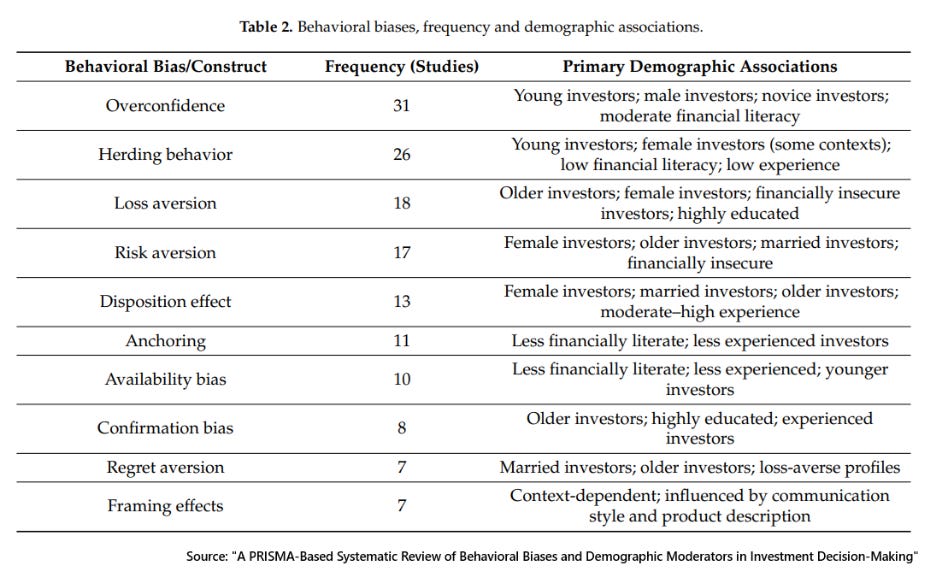
A key takeaway is that behavioral tendencies are predictable, profile‑specific, and ultimately manageable—provided investors recognize how these patterns shape their decisions.
A closer review of the paper’s key findings highlights the following points:
Overconfidence and herding dominate investor behavior. Younger, male, and less experienced investors show the strongest tendency toward overconfidence and socially driven herding—patterns that often lead to overtrading, poor diversification, and momentum chasing.
Financial literacy is among the most significant moderators—when it’s high. High literacy reduces most biases. By comparison, moderate literacy increases overconfidence, echoing the Dunning–Kruger effect (a cognitive bias in which people with low or moderate skill in a domain overestimate their ability). Meanwhile, low literacy amplifies availability bias (focusing on the most recent information and data), anchoring (fixating on initial values), and impulsive trading.
Gender and age effects are real—but often disappear once literacy and income are controlled. Women and older investors exhibit more loss aversion and risk aversion, but these differences shrink substantially when financial literacy and socioeconomic factors are included. Behavioral risk appears to be more environmental than innate.
Experience helps—until it doesn’t. Low experience is associated with overconfidence and herding. Moderate experience corresponds to the strongest decision quality. High experience tends to reinforce the disposition effect (selling winning investments too early and holding losers too long) and confirmation bias (favoring information that supports existing beliefs). In short, experience doesn’t eliminate behavioral tendencies—it changes their form, not their likelihood.
Perhaps the most striking finding in the research is the view that behavioral risk is not a universal phenomenon—it’s a demographic pattern. That means advisors may be better positioned to improve outcomes for investors by tailoring communication, coaching, and portfolio design to investor profiles rather than relying on one‑size‑fits‑all behavioral guidance.
The emerging research makes one lesson unmistakably clear: behavioral risk is not a monolithic challenge but a patterned, measurable, and manageable one. Investors bring distinct psychological profiles to the table, and those profiles shape how they perceive risk, process information, and respond to market conditions.
To manage behavioral risk, the solution may not be generic behavioral coaching but targeted interventions—communication calibrated to literacy levels, guidance tailored to experience, and portfolio structures aligned with each investor’s psychological tendencies.
