

By James Picerno | The Milwaukee Company
The 10‑year yield is near the top of its recent range, raising pressure for stocks
Relatively elevated “risk‑free” Treasury yields are tougher competition for equities
The latest rise in rates tilts the near‑term risk outlook for stocks toward caution
The 10‑year Treasury has rebounded to the upper edge of its recent range, keeping rate pressure front and center for equity sentiment. Stocks remain steady near record highs, driven by expectations that investment in artificial intelligence and tech will continue to provide earnings support. Yet the benchmark Treasury yield’s elevated level leaves the market waiting for the next catalyst—whether fresh inflation data, a shift in Fed expectations, or a geopolitical jolt—to determine if rates continue to move higher or begin to ease and give risk assets some breathing room.
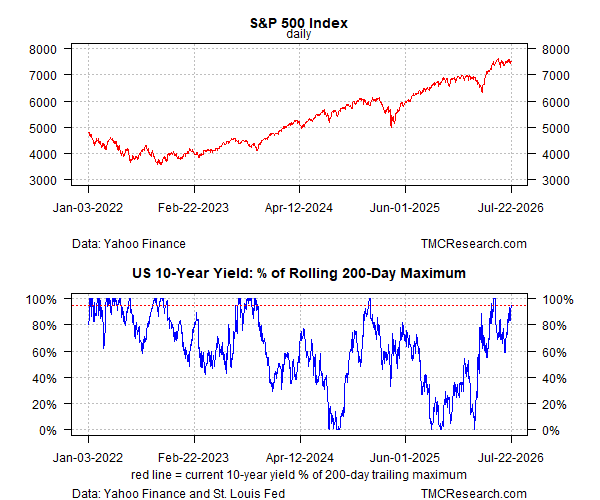
Treasury yields are one of many factors that shape how Wall Street weighs the near‑term outlook for stocks versus bonds, but relatively extreme levels in bond‑market rates vs. the recent past can resonate. When the 10‑year rises, “risk‑free” income looks more attractive, making bonds a stronger competitor to equities. When yields fall, the allure eases, arguably pushing investors toward stocks. In effect, the 10‑year can act as a signal for when conditions appear attractive for leaning into growth (equities) or shifting toward safety (bonds).
The relationship isn’t perfect, but it does tend to rhyme through time. One way to monitor the link between the asset classes is to track the 10‑year yield in terms of its current level vs. its trailing 200‑day window. History suggests that when the benchmark rate’s relative valuation is elevated, the increase implies that the potential for equity volatility may rise. That dynamic was highlighted by TMC Research in previous updates – in mid-February 2025, for example, which showed the indicator approaching levels that have historically aligned with a more cautious equity backdrop.
On that basis, the recent run‑up in the 10‑year yield, in both absolute and relative terms, could be a new headwind for stocks. Equities tend to outperform bonds by a wide margin in the long run. But the periodic opportunity in Treasuries to earn a relatively high share of the long‑term return that stocks typically deliver—while taking far less risk—creates robust competition. When investors can lock in a strong, “risk‑free” payout, the appeal of taking on stock‑market volatility diminishes, if only on the margins.
Bonds are never a replacement for stocks, especially when designing an asset‑allocation strategy for medium‑ to long‑term horizons. But as the chart above suggests, the expected risk for stocks in the near term is not static; it ebbs and flows for a variety of reasons.
One is the degree of influence the bond market exerts through current yield, which can be “locked in” by buying and holding an individual fixed‑income security to maturity. Based on the chart above, the case for viewing the latest rise in the 10‑year as a meaningful, if still debatable, challenge to equity sentiment appears to be strengthening.
