

By James Picerno | The Milwaukee Company
Inflation and most Treasury yields eased in 2025, despite tariff fears
The risk appetite for stocks in 2026 may be closely linked to how Treasury yields
The 30-year yield was essentially unchanged in 2025, hinting at lingering inflation concerns
When President Trump raised tariffs in April, the policy change prompted forecasts of rising interest rates triggered by higher inflation. But those concerns turned out to be off the mark, or at least premature.
Compared with the start of 2025, inflation eased in year-over-year terms in recent months via the Consumer Price Index, as of November. Most Treasury yields also downshifted by the close of 2025 compared with where they began.
The bond market may have outperformed expectations last year, but the optimism could prove fragile if tariff-related inflation revives. By some accounts, inflation is still a concern and a delayed reaction for pricing pressure could emerge in 2026.
Three key Treasury yields deserve close attention in the new year for assessing if the bond market’s calculus is shifting. In turn, the directional bias for yields will likely be a crucial factor for stocks and the economy in 2026. Hanging in the balance is the question: Will last year’s bullish sentiment continue?
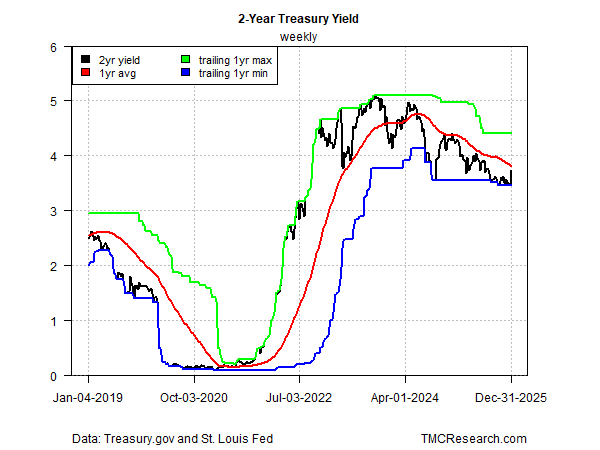
The directional bias for Treasury yields will likely be a key factor. Let’s start with the policy-sensitive 2-year yield, which is widely considered a benchmark for estimating the market’s outlook for the Federal Reserve’s monetary policy. During much of 2025, this yield trended lower, suggesting that the market was routinely pricing in Fed rate cuts – a forecast that, so far, has been spot on. Investors will be closely watching this maturity for deciding if the dovish outlook for policy is still timely.
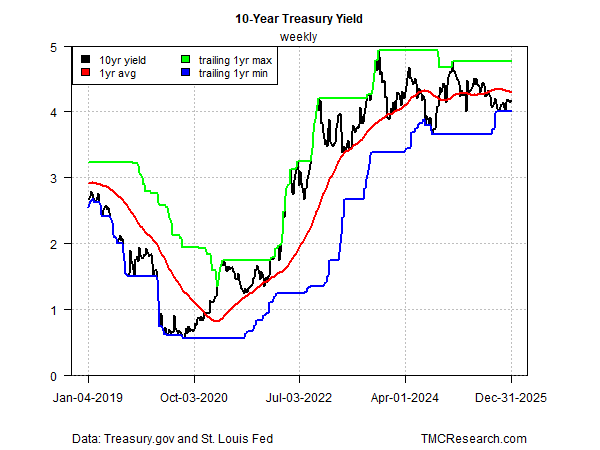
The 10-year yield, which plays a bigger role for influencing lending rates for consumers and the corporate sector, has edged lower recently, but remains in a trading range in recent months. The relatively flat performance of late suggests the market has yet to fully embrace the Federal Reserve’s recent dovish pivot that’s unfolded with three rate cuts in 2025.
Further out on the curve, the 30-year yield reflects a modest upside bias. Since this is the most inflation-sensitive Treasury maturity, the gradual if uneven rise implies that the market isn’t persuaded that inflation risk has faded.
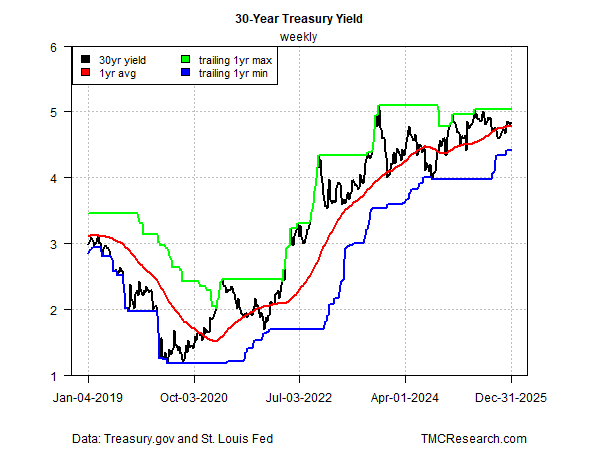
There are many factors that will influence stocks and the economy this year, but Treasury yields could play an outsized role for helping investors decide if 2025’s robust risk appetite continues this year. A key metric to watch that could trigger a warning for risk assets: If one or more of the Treasury yields above break above their trailing one-year maximum level.
As the charts above suggest, such a shift looks unlikely in the near term for the 2- and 10-year maturities.
By contrast, the 30-year yield is relatively close to its upper band for the past year. If there’s a clear change in bond-market sentiment, it appears likely to emerge first in the long bond.
