

By James Picerno | The Milwaukee Company
Expecting an inheritance tends to change behavior long before the money arrives, new research shows
Younger adults generally react with the strongest shifts in saving, risk taking, and work habits
Expecting an inheritance can potentially promote riskier financial choices
No one complains about inheriting money, but new research shows that the prospect of a windfall tends to meaningfully reshape behavior long before any assets arrive. As the authors of “How Inheritance Expectations Shape Financial, Employment, and Family Decisions” explain in an intriguing working paper:
Individuals who expect to receive an inheritance save less, take more financial risks, work fewer hours, put more effort toward personal over career goals, and express greater investment in familial relationships.
The research finds that the effects can be significant even when the expected inheritance is years away. The authors report that expectations alone “can shape economic and social decision-making long before any assets change hands.”
The analysis arrives at a pivotal moment for personal finance. Citing a Cerulli Associates study, the paper notes that the U.S. is on the cusp of the largest intergenerational wealth transfer in history: an estimated $72.6 trillion in inheritances by 2045, including $53 trillion expected to pass from Baby Boomers to their heirs. A key caveat, however, is that longevity, rising healthcare and long-term-care costs, and higher retirement spending may substantially reduce the amount ultimately transferred to heirs. Recent estimates from Visa suggest the net transfer could be closer to $36 trillion after such outflows.
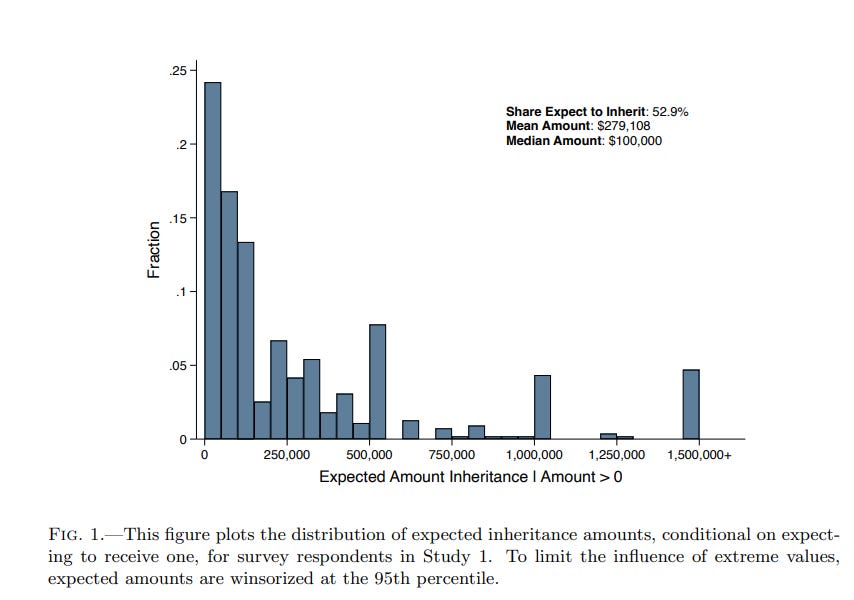
Whatever the final amount, the coming wave of asset transfers is hardly a secret and is already influencing behavior. In new surveys, the paper’s authors report that roughly 18% of respondents have already received an inheritance, and more than half expect one in the future. The chart below, taken from the study, shows a median expected inheritance of $100,000 and an average of $280,000.
Most inheritances may not be enough to dramatically transform long‑term lifestyles. But the anticipation of that money can still reshape financial habits well before the check clears.
The behavioral effects tend to be most pronounced among younger adults, creating concerns for long‑term financial planning. Some may be undersaving on the assumption that future wealth will bail them out. Expectations can create a false sense of security, even though the timing and size of an inheritance are often uncertain.
The study also finds that people expecting an inheritance are generally more willing to borrow, invest aggressively, or take financial risks. Outside of a disciplined investment plan, that shift can be problematic. Believing that a future windfall will cushion mistakes can make risky choices feel safer than they truly are.
Whether or not an inheritance ever arrives, beliefs about future money can quietly—and immediately—shape financial life today. Expectations influence saving habits, risk tolerance, career decisions, and even family relationships.
The paper’s key takeaway for investors: Optimistic or inaccurate expectations about future inheritances can potentially distort financial behavior by reducing saving, encouraging excess risk‑taking, and weakening labor effort, leaving individuals more economically vulnerable.
The authors argue that clearer information on end‑of‑life and long‑term‑care costs, stronger financial literacy programs, improved retirement disclosures, and broader eldercare insurance coverage could help align expectations with reality. Such interventions matter not only for older adults planning their estates, but also for younger people whose financial decisions are already shaped by anticipated wealth.
The inheritance that changes you the most, in short, may be the one you haven’t received yet.
