

By James Picerno | The Milwaukee Company
Narratives can move prices, too, influencing investors beyond “normal” market volatility
Perceived risk can overtake actual risk when narratives dominate
Hidden narratives can quietly steer investment decisions
Are you reacting to market volatility – or stories about it? Both can potentially steer investors off course from their long‑term financial goals without careful planning, but one is more subtle, and therefore can pose a bigger risk.
So‑called narrative risk comes in many forms, including content from social and mainstream media. That creates a threat that can be especially stealthy for otherwise sound judgment in money management. Consider market volatility: when it strikes, it’s obvious, reflecting a measurable move in asset prices. Sharp drops in the stock market are immediately evident, not to mention expected for anyone who studies financial history in the context of long‑term planning. A carefully designed diversified portfolio, rebalancing rules, and a long time horizon all assume volatility will show up.
By comparison, narratives about market volatility can be more understated and, for some investors, fly under the radar. That’s a problem: if you are not aware of narrative risk, you may not be prepared for it.
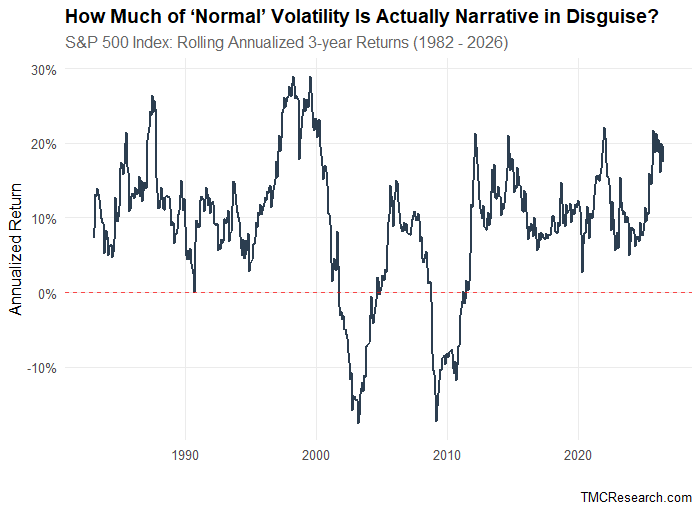
Behavioral Traps and Narrative Risk
Recent research highlights the potential for trouble. The power of financial narratives arises from the emotions they generate.
“We find investor emotions are associated with up to 52% of market returns and 67% of market uncertainty during these market crises, and provide general evidence that investor emotional dynamics may be time and context invariant,” advise the authors of “Narrative Emotions and Market Crises,” a study published in the Journal of Behavioral Finance last year.
Another recent study – “Competing Narratives in Financial Markets” – outlines how viral narratives can drive bubbles, crashes, and volatility through opinion dynamics, fueling the possibility that competing stories can create instability even without new economic information. The key takeaway: Viral stories and social media hype can be a bigger factor in changing asset prices compared with a company’s actual financial health. By simulating a digital stock market, the researchers demonstrate that when investors split into opposing groups—like “bulls” who believe a stock will skyrocket vs. “bears” who think it will crash—their social circles turn into echo chambers that fuel massive, unpredictable price swings.
When Narratives Become Market Movers
The lesson for investors is to be alert to herding behavior, a.k.a. FOMO or fear of missing out. When the crowd buys into a stock purely because a certain narrative goes viral, it may create unstable price bubbles that can violently burst the moment the crowd changes its mind.
Some researchers find that market crises are fundamentally psychological events. Because these emotional narrative cycles repeat almost identically across history, sophisticated investors should monitor mainstream financial media narratives not just for “facts,” but as a barometer for collective anxiety or denial. Recognizing when a market is heavily decoupled from fundamentals and driven by narrative‑induced emotions can help investors avoid panic‑selling during crashes or over‑buying during bubbles.
Narrative risk appears to be a growing threat as social media deepens its reach and influence among investors. And unlike traditional volatility, which is visible on a chart, narrative volatility is invisible until it has already shaped behavior. That’s what makes it so hazardous: it doesn’t attack the portfolio first — it attacks the decision maker.
When stories about markets become louder than the markets themselves, investors may start reacting to perceived risk rather than actual risk. A headline that “stocks are plunging” can trigger anxiety even if the underlying move is routine and within a “normal” range. A viral post claiming a stock is “the next big thing” can override years of disciplined planning. In both cases, the narrative (rather than the fundamentals) can become a catalyst—perhaps unconsciously—for action.
For long‑term investors, the implication is clear: managing money requires managing the information ecosystem that surrounds it. That means:
Treating narratives as data. If the emotional tone of financial news is spiking, that’s a signal that collective psychology may be shifting.
Separating noise from signal. Volatility is normal; narrative amplification is optional. Investors who can distinguish between the two are less likely to overreact.
Re‑anchoring to fundamentals. When stories become extreme, returning to earnings, cash flows, valuations, and long‑term goals provides a stabilizing counterweight.
Building behavioral guardrails. Pre‑committed rebalancing rules, automatic contributions, and written investment policies generally help neutralize narrative‑driven impulses.
The bottom line: market volatility tests portfolios, but narrative volatility tests investors. The former is built into every financial plan; the latter can quietly unravel one. In an age when stories spread faster than facts, the real competitive advantage is not predicting the next narrative — it’s refusing to be ruled by it.
