

By James Picerno | The Milwaukee Company
The upcoming consumer inflation report for August could influence the Fed’s interest-rate decision at next week’s policy meeting
Most forecasts point to steady inflation, but rising services-sector costs raise the risk of an upside surprise
Persistent inflation and mounting fiscal concerns suggest price pressures may remain higher for longer
This Friday’s consumer inflation report will be closely watched on Wall Street for clues about whether the Federal Reserve will raise interest rates at next week’s policy meeting. Although inflation is no longer accelerating, it remains relatively sticky and still well above the Fed’s 2% target, a gap that suggests the central bank may soon resume tightening monetary policy.
Several forecasts indicate that both headline and core measures of the Consumer Price Index (CPI) will remain essentially unchanged. Meanwhile, survey data on prices paid in the services sector – the dominant driver of US economic activity -- suggest that the report could come in hotter than expected.
Here’s a quick rundown of some of the metrics informing expectations for this week’s CPI release:
Cleveland Fed’s CPI nowcast: The regional Fed bank estimates that pricing pressures will remain sticky at current levels, meaning inflation will stay above the Fed’s 2% target. Friday’s August CPI report is projected to hold steady at roughly a 3.4% year-over-year pace, while core CPI is expected to tick down to 2.4%. September nowcasts point to more of the same.
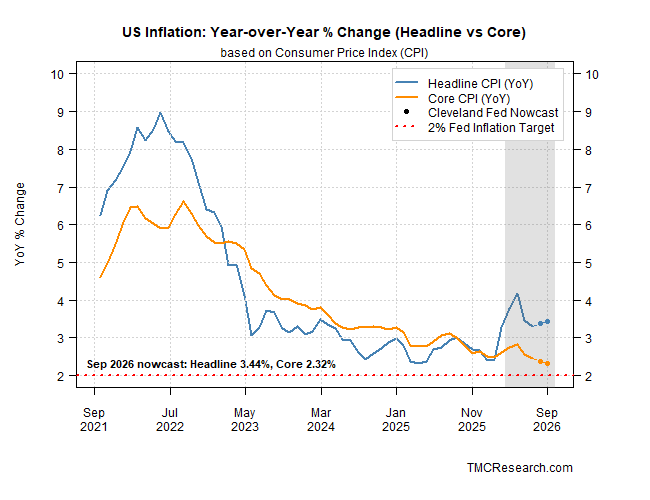
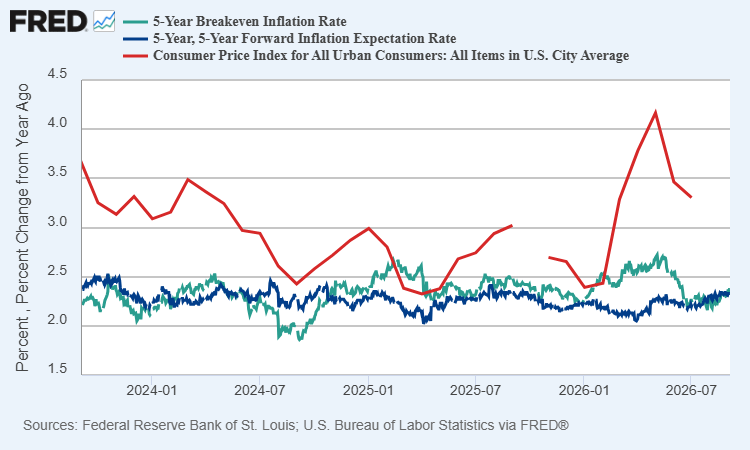
Market-based inflation estimates: A pair of forecasts derived from market data suggests that the headline pace of CPI (red line in the chart below) will decelerate from the mid-3% year-over-year range and move closer to the low-to-mid-2% range in the near term. A similar outlook is implied for core CPI, which excludes volatile food and energy prices. The rationale for using core CPI as a benchmark is that it provides a more reliable measure of the underlying trend, and on that basis these forecasts suggest that the recent gap between headline and core inflation will narrow in the months ahead.
The 5-Year / 5-Year Forward Inflation Expectation Rate reflects investors’ expectations for average inflation over the five-year period that begins five years from now. The indicator currently stands near 2.3%, suggesting that financial markets generally expect long-term inflation to remain relatively close to the Federal Reserve’s 2% target despite ongoing near-term inflation concerns.
The 5-Year Breakeven Inflation Rate is considered a proxy for investors’ expectations for average inflation over the next five years, based on the yield spread between conventional Treasury securities and Treasury Inflation-Protected Securities (TIPS). Currently near 2.4%, the estimate suggests that markets expect inflation to remain above the Fed’s 2% target in the medium term, though well below the elevated inflation rates experienced in recent years.
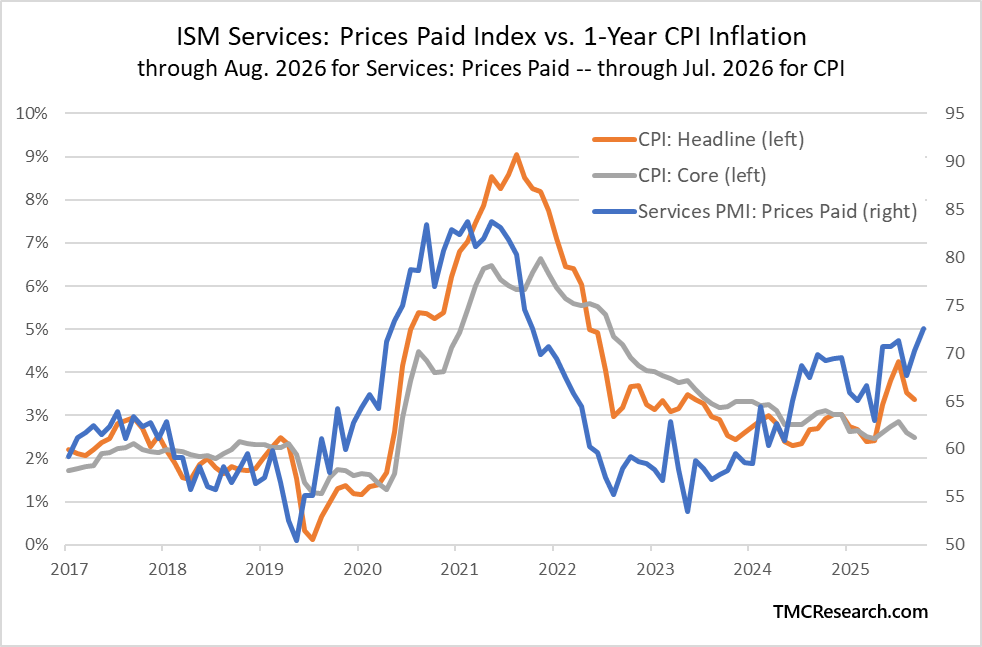
ISM Services Index – Prices Paid: One sign that Friday’s CPI data could surprise to the upside is the recent upswing in this survey-based measure (blue line in the chart below), which tracks whether firms in the services sector are paying higher or lower prices for goods and services. The index is considered a leading indicator of inflation, and the recent increase points to the possibility that inflation may stay elevated for longer. The August reading of 72.6 marks the highest level in more than three years, well above the neutral 50 threshold, implying an above-average risk that incoming CPI data could come in hotter than expected and perhaps rise further relative to the recent trend.
There are several additional factors that could potentially influence inflation in the months ahead, including the ongoing Iran conflict. A durable peace agreement, if achieved, could provide a meaningful disinflationary impulse by increasing energy exports and lowering oil prices, a key driver of headline inflation metrics. The escalation in fighting this week, however, suggests that peace will remain elusive in the near term.
Even if tensions in the Middle East ease, the bond market is becoming increasingly sensitive to U.S. fiscal risks, which is adding to inflation concerns. The prospects for the federal government to meaningfully address its debt burden remain limited, as political incentives continue to favor higher spending and lower taxes over long-term fiscal restraint. Despite growing concern about rising deficits and debt, there is little evidence that policymakers are prepared to make the difficult fiscal adjustments necessary to materially improve the nation’s long-run outlook.
For now, that leaves investors balancing competing forces: inflation that has stabilized but remains stubbornly above target, and a fiscal backdrop that risks keeping long-term inflation expectations elevated. Friday’s CPI report is unlikely to settle that debate, but it could provide an important signal about whether the economy is moving closer to price stability or entering a period of renewed inflation pressures.
