

By James Picerno | The Milwaukee Company
Small caps are outperforming in 2026, fueled by stronger earnings expectations and bargain valuations.
AI‑linked holdings and a resilient U.S. economy are adding momentum to the rally.
The Fed tailwind could vanish quickly if the Iran crisis reignites inflation and forces renewed tightening.
Small-cap stocks are outperforming large caps and the broad market this year. Will it last?
It’s a reasonable question, given the multiple false starts in recent years when small caps took the lead only to trail soon after and yield to large caps. Analysts say this time could be different, citing several favorable tailwinds.
One possible driver is implied via performance history, which suggests small caps may be overdue for a run of outperformance after trailing larger firms for much of the past five years.
Investors in lesser-capitalization stocks are hoping for a rotation in leadership comparable to the roughly six-year runs of small-cap dominance in 2000–2006 and 2008–2013, based on the ratio for two ETFs: SPDR S&P 500 (SPY), which is heavily weighted in large caps, vs. iShares Core S&P Small-Cap ETF (IJR). As shown in the chart below, when this ratio is rising, large caps are outperforming; when the ratio falls, small caps are winning.
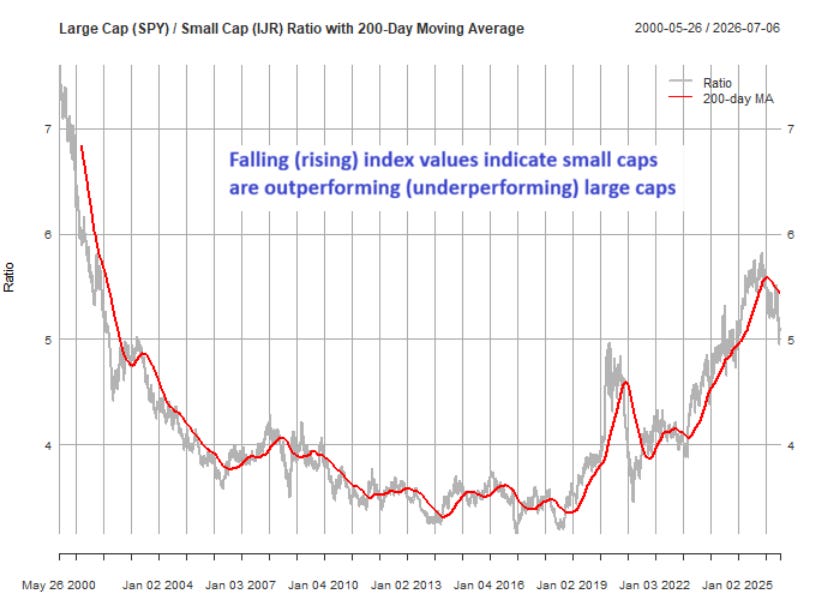
Keep in mind that outperformance sometimes means losing less. But so far in 2026, the small-cap edge is strong in both relative and absolute terms. The iShares Core S&P Small-Cap ETF (IJR) is up nearly 23% this year through July 6, according to Morningstar.com. That’s more than double the advance for the SPDR S&P 500 ETF (SPY).
Analysts cite several factors for the tailwind in small caps that could keep the party going, starting with a bullish outlook for earnings. Estimates for 2027 for the S&P 600, a small-cap index, have improved sharply relative to this year and 2025, according to Yardeni.com, a research shop. The forecasts also compare favorably vs. the outlook for large cap earnings (S&P 500).
Another driver, which may be underappreciated: small-cap indexes hold semiconductors and other stocks linked to artificial intelligence and the recent surge in related infrastructure spending. As one example, Morningstar reports that the tech sector recently represented around 15% of holdings for the iShares Core S&P Small-Cap ETF (IJR), which includes MaxLinear (MXL), a maker of radio-frequency and mixed-signal chips that has jumped as cloud platforms and semiconductor firms accelerate buildouts for AI-driven connectivity.
Comparatively attractive valuations for small caps are also supportive. In contrast with the big-cap AI- and tech-driven large-cap space, which have posted lofty price-to-earnings ratios, small-cap valuations started the year at a steep bargain by comparison -- approaching the lowest levels relative to large-caps in decades, according to one estimate.
A resilient US economy is also a factor. Strategists at Goldman Sachs advise that the business cycle “is usually the most important macro driver of small-cap US equities,” according to a research note published last week.
The path ahead for inflation could be a risk factor due to conflict with Iran, which has increased pricing pressure through a surge in energy costs. Although stocks generally can come under pressure if inflation heats up and the Federal Reserve responds by raising interest rates, small caps tend fare worse. One reason: Small‑cap firms are generally less profitable and more credit‑dependent, making them especially vulnerable to a surge in borrowing costs because they pay higher rates, face shorter‑term loans, and are exposed to greater interest‑rate volatility, strategists at Charles Schwab observe.
Relative calm in the Middle East, however, suggests inflation may have peaked. The Cleveland Fed’s latest nowcast show the year-over-year change the Consumer Price Index is expected to ease for the first time since the war began. The question is whether the return of military strikes this week threatens to renew inflation’s pulse.
The futures market is pricing in moderately high odds that the Federal Reserve will keep its target interest rate unchanged at the next policy meeting on July 29. A rate hike in September, however, is considered likely.
The recent tailwind from a steady Fed could prove fleeting if the Iran crisis escalates and energy prices surge again, rekindling inflation pressures and potentially forcing policymakers back into a tightening mode. In that scenario, small caps could once again take a back seat to large caps. For now, though, the small‑cap edge remains intact as 2026 enters its second half.
