

By James Picerno | The Milwaukee Company
Market volatility reveals an investor’s true risk tolerance
Behavioral biases often distort how much risk people think they can handle
Use market drawdowns as diagnostic feedback to assess true risk tolerance
Thinking about risk tolerance may be an afterthought for some investors, but it’s a crucial component. The reason: a key part of investing success is ensuring that an individual owns a portfolio that’s appropriate for a given risk tolerance.
Identifying a suitable risk tolerance can be tricky because what an investor thinks he can endure in theory may not be realistic in practice. That’s a problem because a mismatch can lead to panic selling at or near market bottoms.
The recent market volatility has been a useful stress test for gauging how someone reacts under pressure—panic, patience, or something in between. Monitoring reactions during market corrections may provide a more accurate read on the capacity to handle downturns compared with questionnaires and other efforts to quantify investor behavior.
In other words, market volatility is more than short‑term noise to be endured. It’s also a diagnostic tool that can reveal the degree of emotional resilience and decision‑making under stress.
Consider the drawdown history of the S&P 500 Index, proxied in the chart below by the SPDR S&P 500 ETF (SPY). The latest selloff, following the start of the war with Iran, left the S&P down nearly 9% from its previous high. The drawdown in the spring of 2025, during the tariff‑related decline, cut the market even deeper—a 19% peak‑to‑trough drop at one point. Observing behavior during these events offers an opportunity to determine an investor’s true level of risk tolerance.
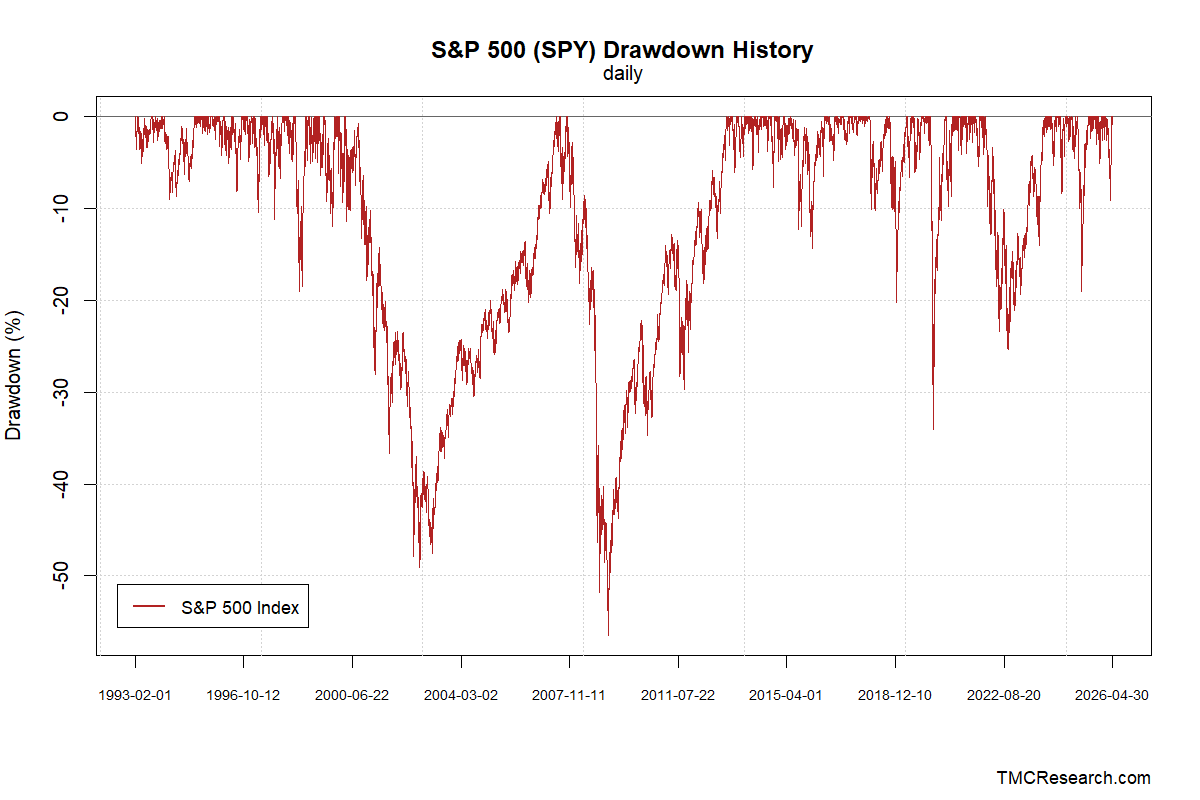
Market declines can get much worse, as the 2008 crash reminds. During that event, the S&P fell nearly 52% from its previous high.
Volatility is a feature, not a bug, of financial markets, which highlights the potential for trouble if investors overestimate their risk tolerance. That’s a non‑trivial issue because everyone suffers from various behavioral biases, according to numerous studies over the years. Examples include overconfidence bias (investors overestimate their abilities and knowledge), herd mentality (mimicking the actions of a larger group), and loss aversion (investors experience a deeper emotional impact from losing vs. winning the same amount of money).
The challenge is compounded because researchers have documented a gap between what investors say about risk perceptions and how they behave.
The good news is that there are various strategies for managing risk so that an investor’s portfolio aligns with her risk tolerance, which can be expressed as a subjective, psychological willingness to lose money. A foundational approach is building a globally diversified portfolio and structuring the asset allocation to match the investor’s risk tolerance, time horizon, and other factors unique to that person.
Developing a rebalancing plan and working with a financial advisor can also help.
In the end, volatility doesn’t just test portfolios—it tests people. Investors who treat these episodes as feedback rather than failure gain something far more valuable than short‑term returns: a clearer understanding of the risk they can truly live with.
