

By James Picerno | The Milwaukee Company
Personal experiences may influence economic expectations as much as new information
Stress and memory may shape how investors perceive inflation and market risks
A disciplined investment process generally helps separate emotions from financial decisions
Investors spend a lot of time monitoring market volatility, interest rates, and inflation. And for good reason: those variables directly impact financial markets in the near term. But new research reveals that one underappreciated behavioral challenge can arise from a far less obvious source: our own memories and personal stress.
In a study titled “The Psychology of Macroeconomic Expectations”, a team of researchers from several institutions, including Oxford and Harvard universities, challenge the traditional belief that people form economic views purely by analyzing data. Instead, the authors demonstrate that emotions, recent personal experiences, and selective memory often influence how people forecast inflation, housing prices, and broader economic conditions.
The research echoes what economist John Maynard Keynes observed in his 1921 book A Treatise on Probability, which argues that when the facts are murky, people tend to piece together beliefs from imperfect and shifting evidence rather than strictly applying the laws of probability. Keynes expanded on the idea in The General Theory (1936), coining the phrase “animal spirits” to describe the impulses and emotions that drive human behavior.
The new study tests this mechanism by asking participants to recall recent personal financial or health-related hardships before reporting their economic outlook. The results are striking: respondents who were prompted to recall personal adversities reported different inflation and housing-market expectations, despite receiving no new economic information.
Confusing Personal Stress with Market Risk
This research, which draws on results from a survey of more than 4,000 households, suggests why two intelligent, well-informed investors may interpret the same economic information in different ways. Their expectations are shaped not just by market fundamentals, but by the personal experiences that come most readily to mind.
As an example, the authors observe: “The feeling of personal financial distress helps imagine high future inflation.” In other words, personal stress can influence how people perceive future economic conditions.
One implication is that during periods of life changes or business challenges, emotional context can cue associative memories that influence how investors interpret economic and market conditions and expectations.
The paper highlights a reason people may arrive at different assessments of economic risks. Even when an investor is trying to make a rational forecast, emotional context can activate emotionally charged memories.
Note, too, that behavioral risk rarely stays isolated. The authors also describe a “confidence multiplier,” in which the behavior of some individuals influences the economic outlook of others through shared context and narratives. This raises the possibility that when media outlets and market participants react to emotional cues, their actions may reinforce prevailing narratives and amplify shifts in sentiment.
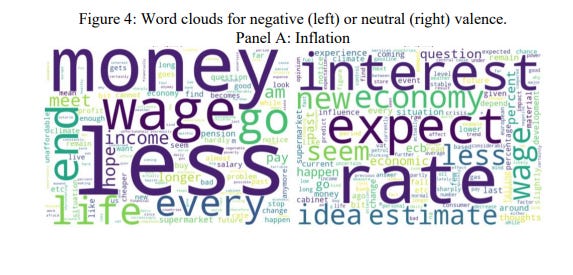
The researchers used word clouds to visualize how people explain their economic outlook. Responses reflecting personal hardships and negative experiences feature more references to money, hardship, and making ends meet (left side of graphic below), while more neutral responses focus on broader economic factors such as interest rates, supply, and demand (right side). The findings suggest that personal experiences can influence how people interpret economic conditions and form expectations about the future.
Why This Matters for Investors
Although the paper doesn’t formally address investing or portfolio strategy, the findings tend to suggest a possible behavioral channel through which personal experiences may influence investment decisions.
On that basis, the research highlights a core challenge for long-term investors: unexamined personal experiences may quietly hijack financial decisions in ways that have nothing to do with market reality.
After a financial setback, an investor may become excessively cautious. Following a period of strong gains, another investor may become overly optimistic. Neither response is necessarily driven by objective analysis. Instead, recent experiences may be influencing how future outcomes are perceived.
The research suggests that beliefs and economic narratives are often shaped by context and memory, not just statistics.
The Value of a Disciplined Process
This is where professional wealth management can provide meaningful value.
A thoughtful advisory relationship is about more than portfolio construction. It is also a framework for maintaining perspective during periods of market uncertainty. By creating a disciplined investment process and focusing decisions on long-term goals, investors may be better positioned to avoid making significant changes based solely on short-term fears or recent experiences.
The goal is not to eliminate emotions, which is impossible. The objective is to ensure that important financial decisions are guided by a well-designed plan rather than by whatever experience happens to be most salient at the moment.
Building a More Resilient Wealth Strategy
Successful investing requires more than identifying attractive opportunities. It also requires a framework that helps investors:
Focus on long-term objectives rather than short-term market noise
Distinguish between changing market fundamentals and changing emotions
Maintain discipline during periods of uncertainty
Avoid reactionary decisions that can undermine long-term compounding
A sound wealth-management strategy recognizes that financial success depends on both portfolio management and investor behavior.
The Bottom Line
Markets will always be uncertain. But one of the most important lessons from behavioral research is that our perceptions of the future are often shaped by experiences from the past.
The most effective wealth-management relationships help investors navigate both challenges: managing portfolios and managing their decision-making. Because over the long run, building wealth is not just about understanding the markets. It’s also about understanding ourselves.
