

By James Picerno | The Milwaukee Company
New research suggests that headline-driven market activity often reflects short-term trading rather than lasting changes in investor positioning
A surge in trading volume doesn’t necessarily signal a major shift in investor conviction or the long-term outlook
For long-term investors, dramatic market moves can sometimes reflect changing sentiment rather than changes in underlying fundamentals.
When markets lurch on a surprise headline, it is natural to assume investors are rapidly reassessing the future. A sharp selloff, sudden rally, or surge in trading volume creates the impression that capital is being repositioned on a massive scale. Yet a growing body of research suggests that much of day-to-day market activity is far less consequential than it appears.
Recent academic studies challenge the notion that every spike in trading activity reflects a meaningful shift in long-term conviction. A 2026 Harvard Business School study found that while gross trading volume in U.S. equities has increased roughly fivefold since 1980, "net volume"—trading associated with persistent portfolio reallocations rather than transitory round-trip transactions—has remained largely unchanged. In other words, the study found that trading activity has increased substantially, but persistent portfolio reallocations have not increased proportionately.
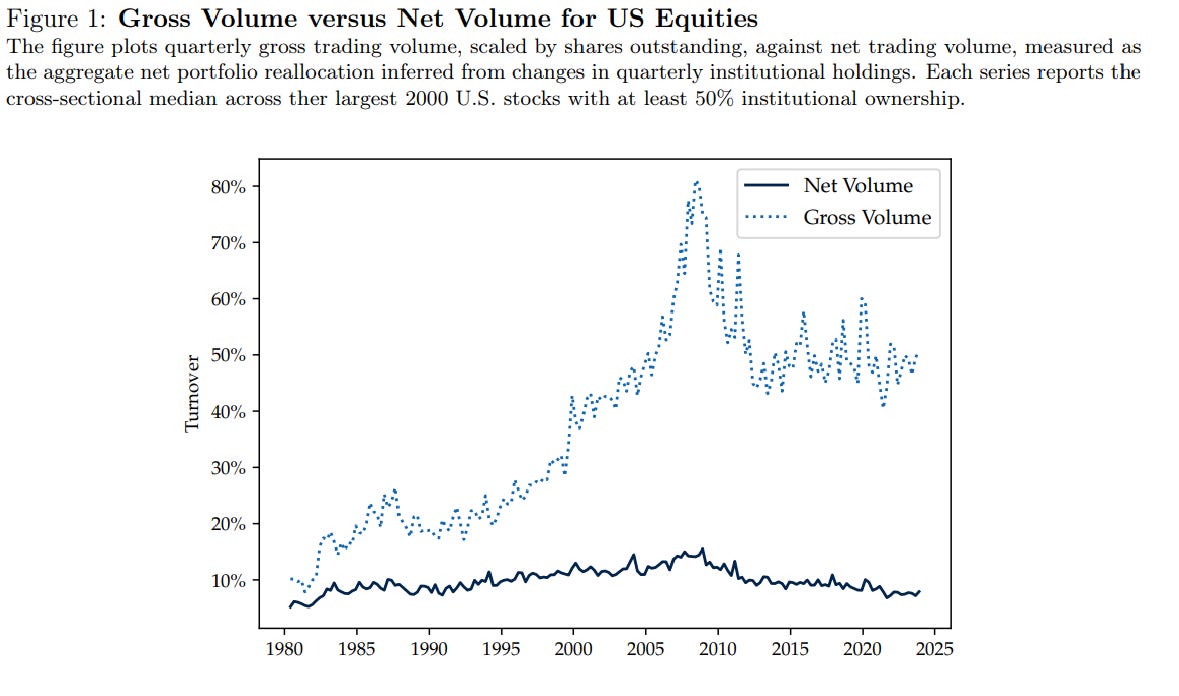
The researchers note that this growth stems primarily from high-frequency market-making. While high-frequency intermediation improves short-term liquidity, it does little to absorb lasting shifts in investor demand. Consequently, measures of short-term liquidity have improved dramatically over time, whereas long-term liquidity and price impact have remained broadly stable.
As the authors summarize:
While gross trading volume has quintupled since 1980, trading volume associated with long-term portfolio reallocations, which we term net volume, has remained largely stable over time... [It] is driven primarily by high-frequency round-trip trading, which may improve liquidity at very high frequencies, but does little to absorb persistent demand shifts over longer horizons.
The practical takeaway is that a volume surge accompanying a market-moving headline may reveal less about long-term outlooks than many assume. Put differently, a high volume of transactions may not always be synonymous with deep economic conviction.
A separate National Bureau of Economic Research (NBER) paper from earlier this year points to a related behavioral tendency. Researchers found that investors frequently overreact to highly visible news stories with ambiguous implications while underreacting to fundamental information, particularly quantitative data and negative news. As a result, certain attention-grabbing headlines can trigger market moves that subsequently reverse, whereas some fundamental information may be incorporated into prices more gradually.
Taken together, these studies offer a timely reminder for investors, particularly those utilizing broadly diversified ETFs and mutual funds: Market volatility is not always a reliable signal that the economic landscape has fundamentally shifted.
Markets can appear exceptionally active, and prices can move sharply, even when relatively little long-term capital is being reallocated. In many cases, the market’s loudest reactions may potentially reflect short-term trading intermediation and investor attention rather than structural changes that impact future returns.
For investors focused on building wealth over years or decades, the lesson is straightforward: resist the temptation to interpret every headline-driven market swing as an urgent call to action. Short-term market noise is frequently just that—noise. A more constructive question is whether the economic and corporate fundamentals underpinning an investment strategy have truly changed.
