

By James Picerno | The Milwaukee Company
Warsh’s Jackson Hole debut on Friday approaches as bond‑market anxiety climbs
Treasury Department comments on market-intervention plans have offered only limited relief for long‑term yields so far
Markets are watching to see whether Warsh shifts his low‑guidance communication strategy
Federal Reserve Chairman Kevin Warsh has made it clear that he wants to say less about monetary policy compared with his predecessors. He also favors curtailing the Fed’s so-called forward guidance efforts – offering clues about future policy decisions. But at a time of elevated anxiety in the bond market, fueled by concerns about fiscal risk and inflation, investors are wondering if Warsh will be forced to revise his communication preferences.
The question — and the tensions behind it — will be in sharp focus on Friday when Warsh delivers what some observers are billing as his first significant public address at the Fed’s annual Jackson Hole meeting. Although he’s only been leading the central bank for a few months, his speech at the end of this week could be a defining moment for his tenure and cast a long shadow over the bond market.
Expectations for what he may, or may not, say are all over the map. By some accounts, this could be a major event that sets the tone for equities and fixed income for the near term or longer. Other Fed watchers are expecting little if anything new in terms of guidance or insight into Fed policy.
What is clear is that the macro backdrop going into Friday’s speech has become more complex. The US Treasury last week announced a plan to raise buybacks of long-term bonds in an effort to cap if not lower rising Treasury yields. The bond market wasn’t impressed and yields continued to rise by Friday’s close.
As a follow-up, two senior Treasury officials on Monday told CNBC that the nearly $1 trillion Treasury General Account could be used to dramatically ramp up bond purchases.
A few weeks earlier, Treasury took joint action with Japan to raise the value of the yen vs. the dollar in a separate bid to minimize upward pressure on US yields.
Debate rages about whether the government’s interventions in markets will be successful in stabilizing if not lowering long-term yields. There are hints of success as of Tuesday. The 30-year yield, for instance, has pulled back to 5.17% after briefly jumping to nearly 5.34% in intraday trading last week, marking a 19-year high.
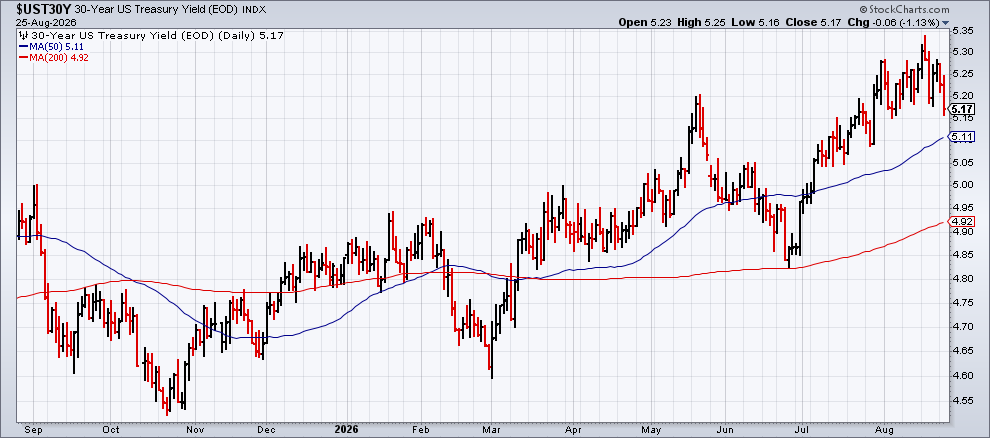
The question is how the market will price in the risks that have lifted yields – risks that may not be going away any time soon. Iran-related inflation vis-à-vis energy is one source of concern. Another is ballooning US government debt, which topped $40 trillion this month for the first time. Debt as a percentage of the economy appears to be less stark, but only relative to the spike during Covid.
The main challenge is that government efforts to address the deepening pool of red ink – curtailing spending, raising taxes, or both – remain politically unlikely these days in Washington.
A key issue in the near term is whether Treasury yields at the long end of the curve continue to rise. In that scenario, the Fed may be forced to raise interest rates to persuade the bond market that it’s committed to lowering inflation, which has been running above the 2% target for more than five years. Consumer inflation is running at 3.4% a year through July.
Fed funds futures are still pricing in modest odds in favor of no change for the September 16 policy decision, although the market is expecting at least one hike by the end of the year.
Meanwhile, the one-month Treasury yield has turned up recently, moving out of its recent range, which may signal that bond traders are preparing for policy tightening.
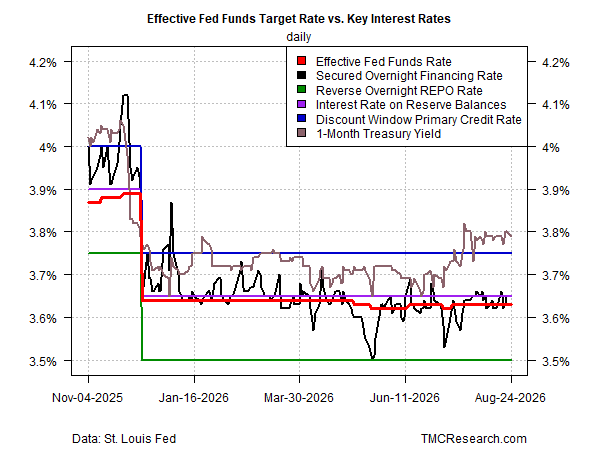
The main event this week is what Warsh says, or doesn’t say, on Friday. Markets will be keenly focused on learning if the Fed chairman uses the annual gathering in Jackson Hole to refine and perhaps update his communications strategy, which had a rocky start in his first two press conferences at the June and July FOMC meetings. Offering minimal insight on his economic and interest rate views, he reasoned that less is more for central bank messaging to markets.
Will he use Friday’s speech to revise that view? Or try to soothe market sentiment with a clear plan to reduce inflation (rather than simply making a general comment that the Fed is committed to price stability, as he has said so far as chairman)?
Alternatively, Warsh may dig in further on his campaign to remove forward guidance and emphasize that markets should price in inflation and economic risks without interference from central bankers. In that case, does the chairman think that bond investors should do the heavy lifting for the Fed and raise yields in reaction to elevated inflation? If so, does the Treasury Department’s latest plans to take a more interventionist approach in markets to lower yields conflict with Warsh’s view of policy framing?
Lots of questions. Perhaps there’ll be some answers on Friday, or not. Either way, the bond market will be watching and reacting.
