

By James Picerno | The Milwaukee Company
TMC Research’s markets-based estimate of Iran War risk still indicates an elevated risk regime
The surge in oil prices is the main driver of heightened risk expectations
Additional factors that are raising risk perceptions: credit spreads, stock market volatility, inflation, and the US dollar
The war with Iran continues to roil financial markets. At some point the risk will peak, providing context for deciding if the worst has passed. Estimating that point will be useful but also challenging in real time, in part because it’s a task that requires analyzing a wide variety of data. As a first approximation, TMC Research is tracking an aggregate of five relevant risk dimensions based on market signals via a set of ETFs.
There are several ways to estimate war-related risk through a markets-based lens. TMC Research’s Iran War Risk Index (IWRI) represents an initial estimate of war-related perceptions. This model can easily be updated in real time for tracking how markets are reacting to news events. Short-term changes can be noisy, and so the daily data are smoothed with a LOESS regression model to highlight the trend.
IWRI is comprised of five inputs that are germane for monitoring the war. ETFs are used as proxies for each variable:
• Crude oil (USO)
• US dollar (UUP)
• Stock market volatility (VIXY)
• Credit spread (IEI–HYG spread)
• Inflation risk sentiment (TIP–IEF spread)
The weights of the five factors are slightly skewed relative to an equal weighting and give oil the highest weight (30%), followed by 25% for the credit spread, 20% for the US dollar, 15% for stock market volatility, and 10% for inflation risk.
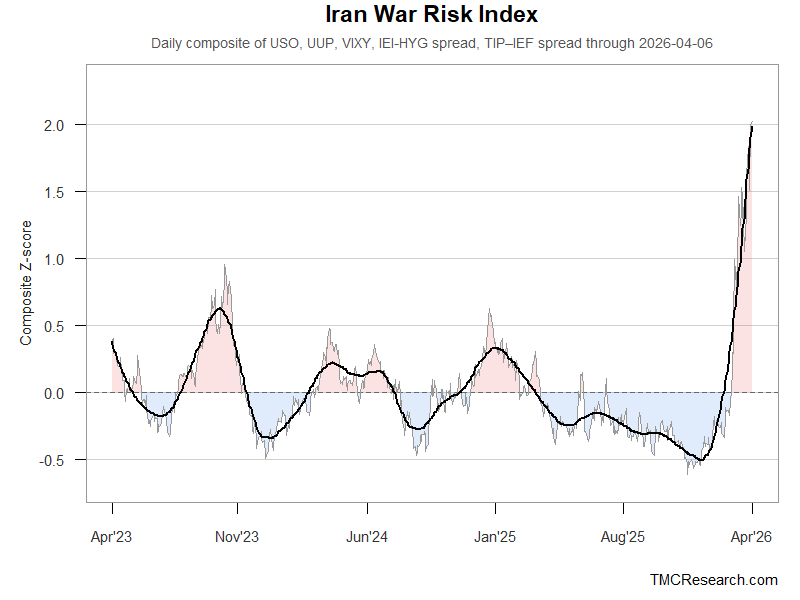
The current reading continues to show an elevated level of risk, as of Apr. 6. The data are shown in z-scores, and so levels above +1 equate with high risk. Accordingly, a drop from the current level below +1.0 may be an early clue that markets are starting to price in de-escalation. Such a change in sentiment, for now, doesn’t look imminent, with IWRI trading above +2.0, which is far above the pre-war range.
A sustained decline in IWRI toward its prewar range would be a sign that markets see the danger fading. Until then, elevated readings suggest that a high-risk narrative remains in play.
