

By James Picerno | The Milwaukee Company
Investors routinely underperform their own portfolios because behavior, not market returns, drives results
Strengthening financial literacy is a highly reliable way to shrink the behavior gap
Professional guidance can help investors stay disciplined when emotions threaten long‑term performance
Predicting financial markets is tough, especially in the short term, but the behavioral habits of the average investor are remarkably consistent in reducing performance. Fortunately, there’s a straightforward fix for some of the biggest behavioral-risk challenges: strengthen investment literacy.
Identifying the problem is relatively straightforward: reacting emotionally to market volatility, for example, can lead investors to panic and make poor decisions. Where things get tricky is adjusting behavior in ways that actually support long‑term financial objectives.
But there’s no debate about the underlying issue. Numerous studies over the years point to an ongoing and uncomfortable truth: investors consistently underperform the very investments they hold.
The issue isn’t flawed portfolio design, which is relatively easy to resolve, particularly for the most-misguided investors. But even the best‑constructed investment strategy will suffer if erratic and ill-advised behavior creates a gap between a portfolio’s return and the lower performance investors actually earn due to poor decisions.
DALBAR, Inc. has been quantifying this so‑called behavior gap for decades. Although the investor penalty rises and falls in any given year, it’s reliably persistent. For 2024, the consultancy reports the “second largest performance gap of the past decade,” with the average equity investor trailing the S&P 500 by more than eight percentage points. The gap narrowed sharply to 72 basis points in 2025, but the average investor still lagged the market.
The behavior gap is also conspicuous for fixed‑income investors, widening to nearly five percentage points in 2025.
Morningstar’s research finds similar results. A recent review of the data reports: “Over the past 10 years, the average dollar invested in US mutual funds and exchange‑traded funds earned 1.2% less per year than what those funds returned during the same period.”
Closing the gap — if not outperforming — is the goal, and the first step is recognizing that behavior is usually far more important than investment selection on average. A recent study by an independent financial researcher underscores how costly emotional decision‑making can be.
“The typical investor suffered a loss of more than 50% of their investment potential because of their own emotional choices rather than market downturns or high costs or wrong investment choices,” advises “Beyond Alpha: Why Financial Education and Behavioral Discipline Outperform Investment Selection in Long‑Term Wealth Management.”
Using DALBAR data, the author adds: “This is not an anomaly. It is the norm.”
Another study a few years ago found that financial literacy is the lowest among the young, based on testing on three questions related to interest, inflation, and risk. “Only 14% of those under age 35 answered all three questions correctly,” according to the FINRA Foundation’s 2021 National Financial Capability Study. “Young people’s financial literacy knowledge lags that of older adults. Nevertheless, less than half of those 66 and older were able to correctly answer the Big Three.”
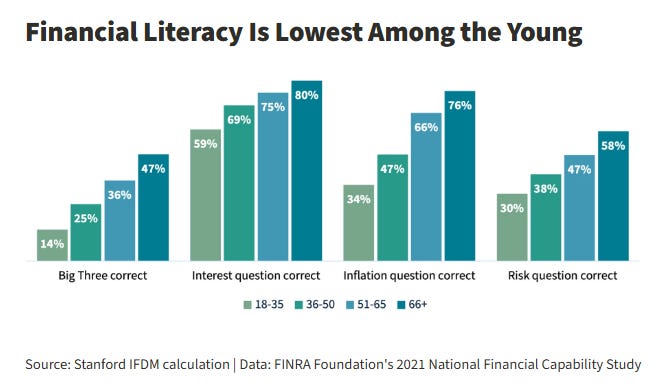
Focusing on financial education as a solution should be the new norm, the “Beyond Alpha” paper concludes. While this advice has always been true, it matters more than ever for several reasons. One is the surge in the Great Wealth Transfer — an estimated $84 trillion moving from Baby Boomers to younger generations in the years ahead.
Three additional factors raise the stakes for developing financial literacy, according to the study:
Investor demographics are shifting: Women, Millennials, Gen Z, and growing numbers of minority investors are accumulating more wealth, yet many still face gaps in financial knowledge and access to quality guidance.
Traditional portfolio management is increasingly commoditized: Low‑cost index funds and other innovations have erased cost and access advantages, making behavioral coaching and client education the true differentiators.
Regulations are raising the bar: Fiduciary standards increasingly emphasize delivering maximum client value, and evidence suggests behavioral coaching can help meet that requirement — meaning advisors who ignore it may risk falling short of evolving regulatory expectations.
Changing human behavior may be challenging, but the benefits of enhancing financial literacy have been shown to improve investment outcomes. A 2014 study in the Journal of Economic Literature found that taking the time to improve financial savvy leads to smarter long‑term decisions and stronger returns.
Not every investor has the time or inclination to self‑educate on the finer points of managing behavioral risk — and that’s exactly where professional guidance becomes invaluable. A skilled advisor can help an investor bridge the gap between good intentions and disciplined execution, potentially turning financial knowledge into lasting financial results.
One of the best financial moves you can make isn’t outsmarting Wall Street—it’s using financial literacy to outsmart your own instincts.
