

By James Picerno | The Milwaukee Company
The Federal Reserve faces crosscurrents as geopolitical shocks and fiscal strain threaten to reignite inflation
Diverging inflation gauges blur the policy signal just as decisions grow more consequential
Markets are split, with some hinting at tightening while others still reflect caution
The outlook for the Federal Reserve’s mandate to control inflation isn’t getting any easier.
The Middle East conflict is escalating again, creating new shipping bottlenecks for energy exports from the region, which could delay—and possibly reverse—the recent disinflationary impulse in the U.S. economy that had appeared set to soften pressure on the Fed to raise interest rates.
Another source of uncertainty is the government’s persistently large fiscal deficit, which risks becoming inflationary as heavy borrowing keeps upward pressure on demand, interest rates, and the overall price level.
Adding complexity to the outlook is the government’s plan to revise how the Personal Consumption Expenditures (PCE) Price Index—the Fed’s preferred inflation gauge—is calculated starting with the September report. The upcoming methodology change reflects the reasonable view that spending patterns and the structure of the modern economy have shifted enough that the index needs updated weights and improved measurement to give policymakers a clearer read on underlying inflation pressures. Nonetheless, the adjustment could be viewed as controversial at a time when current inflation readings remain well above the Fed’s target and rate hikes may be near.
Fed funds futures continue to price in high odds that the central bank will leave its target rate unchanged at next week’s policy meeting (July 29). By year-end, however, futures anticipate one or more hikes.
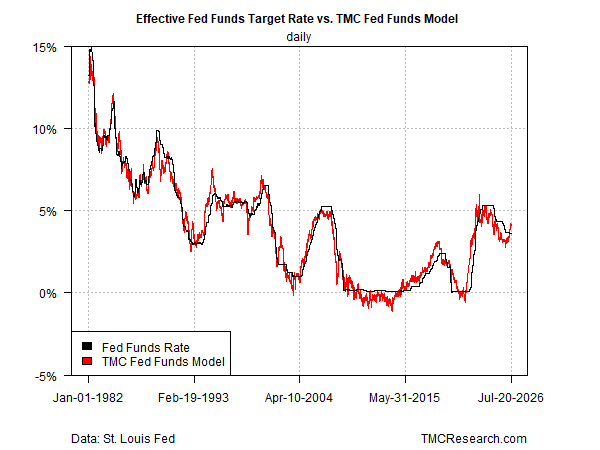
TMC Research’s Fed Funds Model suggests that policy has recently shifted to a modestly dovish stance, crossing into that terrain in May for the first time in more than three years. The switch implies a case for lifting the current 3.50%–3.75% target range to maintain a neutral stance that balances the Fed’s goal of keeping inflation steady or pushing it lower while providing the economy with sufficient liquidity to sustain a growth bias.
Achieving the central bank’s dual mandate—minimizing inflation and maximizing employment—is always tricky, and may be particularly difficult for the remainder of the year. Inflation is being pushed around by forces largely beyond the influence of monetary policy—renewed Middle East conflict, energy‑supply risks, shipping disruptions, and persistent fiscal deficits—while the labor market remains firm enough to resist cooling. That combination leaves the Fed trying to restrain price pressures without derailing employment, a balancing act made tougher by shocks that policy can’t easily offset.
The Fed is also receiving mixed signals at a challenging moment for policymakers: core PCE’s one‑year rate has been drifting higher, the core Consumer Price Index eased in June, and the 16% Trimmed Mean CPI—a measure Chair Warsh has praised as a cleaner read on underlying inflation—is hovering near the Fed’s 2% target. That divergence muddies the policy picture, forcing officials to decide whether inflation is re‑accelerating or simply settling into a slower, more stable trend.
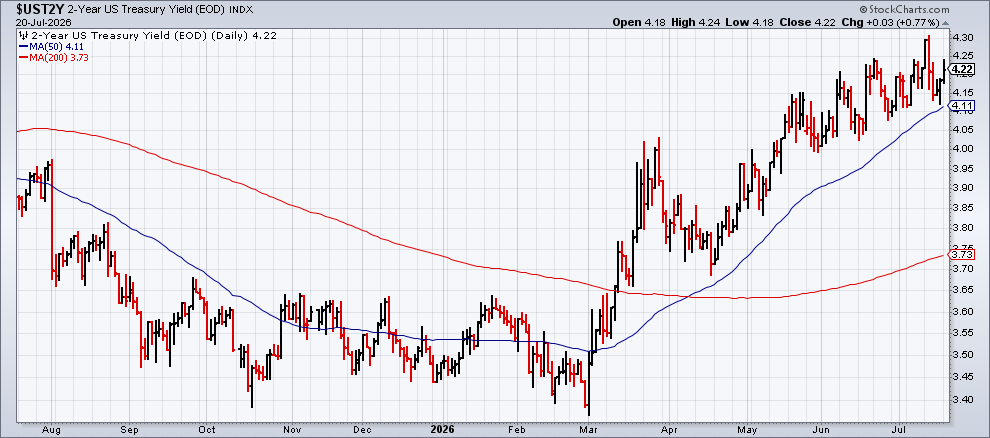
The bond market has been flirting with the possibility that a Fed rate hike is near. The 2‑year Treasury yield—widely viewed as a market‑based proxy for rate expectations—is trading above 4.2% this week, well above the Fed’s current 3.50%–3.75% target range, implying that investors expect a hike.
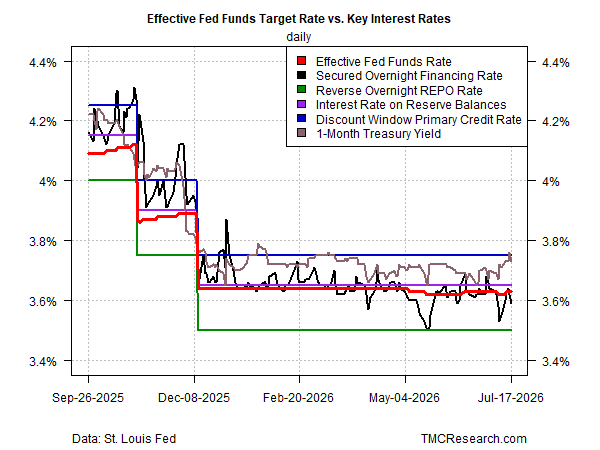
Short‑term market rates, however, suggest that tightening isn’t imminent, per the chart below, which highlights several rates that are sensitive to policy‑bias expectations. A decisive move upward in these rates from current levels could be an early sign that liquidity conditions are shifting to accommodate an increase in the Fed’s target rate, proxied by the Effective Fed Funds Rate (red line).
Despite the relative calm in the bond and rates markets, the next several policy meetings could be more complicated than usual to navigate. Part of the challenge is a rising skepticism about the accuracy of economic data—doubt that could be amplified by the government’s planned September change in the PCE inflation methodology.
As former Federal Reserve and White House economist Claudia Sahm wrote last week: “If we do not all agree on the yardstick, then a commitment to price stability is nearly meaningless.”
Fed Chairman Warsh has made several hawkish comments since taking the helm in May. In what may become his signature statement, he emphasized that the Fed would have “no tolerance” for persistently elevated inflation above the 2% target.
Yet some critics charge that he has not outlined how he intends to achieve that goal or whether PCE remains the formal yardstick. The Fed chief has criticized core PCE in Senate testimony as a “rough swag as to what was going on” with prices. “We don’t have to do a rough swag any more.”
His gray‑zone commentary concerns some Fed watchers, who argue that the lack of clarity, intentional or not, may make the central bank’s job tougher as it tries to keep inflation near its target.
Sahm asserts that “Redefining inflation is not the way to achieve price stability.”
The crucial question is whether the bond market will interpret the shifting metrics, mixed signals, and geopolitical shocks as a sign that the Fed’s inflation‑fighting credibility is strengthening—or slipping.
