

By James Picerno | The Milwaukee Company
The Fed’s first rate hike in three years signals a shift toward tighter policy, but monetary conditions remain modestly accommodative
Strong GDP, payrolls, and retail sales data suggest the economy currently requires little, if any, additional policy support while inflation runs above Fed’s target
Fed funds futures, Treasury yields, and TMC Research’s Fed Funds Model all indicate that additional rate hikes remain likely
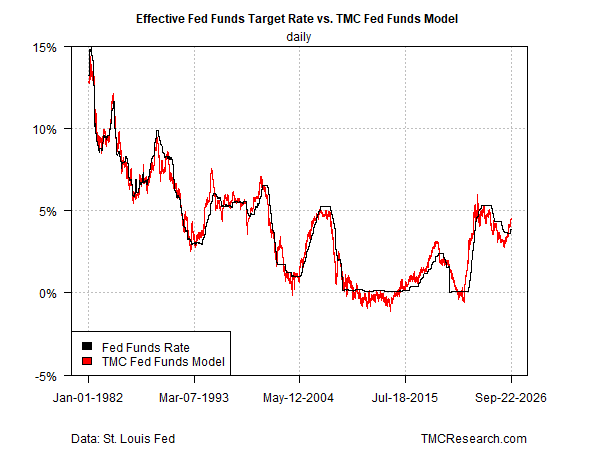
The Federal Reserve raised its target interest rate last week for the first time in three years in reaction to heightened concerns about the inflation outlook. The quarter-point increase is a small step toward taming pricing pressure. TMC Research’s Fed Funds Model continues to estimate that monetary policy has a modestly dovish bias, which implies that additional rounds of tightening are coming.
Our model indicated that policy was moderately hawkish for nearly three years before shifting to an accommodative bias in late spring. This change suggested that the Fed’s stance had become overly stimulative, especially as the conflict with Iran lifted energy prices and put upward pressure on inflation.
The model is currently estimating that the effective fed funds rate is more than a half-percentage point below a neutral level. The reading suggests that policy is still providing stimulus to the economy and providing little, if any, headwind for lowering inflation.
Nowcasts for the upcoming third-quarter GDP report (due in late October) suggest that accommodative monetary policy is unnecessary. The Atlanta Fed’s GDPNow model, for example, is estimating that Q3 output will rise 5.1% at a seasonally adjusted real (inflation-adjusted) pace, a sharp acceleration from Q2’s modest 1.5% increase.
Recent economic updates based on actual data also paint an upbeat picture. Payrolls roared higher in August, rising 162,000, the strongest monthly gain since March. Retail sales also picked up in August, rising 1.2%, marking the sharpest increase in five months.
While recent economic data have been upbeat, inflation is still well above the Fed’s 2% target. The Personal Consumption Expenditures (PCE) Price Index for August, the Fed’s preferred inflation yardstick, was running above 3% in year-over-year terms for both headline and core measures.
Federal Reserve Chairman Kevin Warsh called out the mismatch, noting: “The plain fact is that inflation is too high and has been for too long,” he told reporters after last week’s rate hike announcement. “This summer’s inflation readings do not tell me that underlying trends have meaningfully improved.”
It is no surprise, then, that the market is expecting one or more additional rate hikes in the near future. Fed funds futures are pricing in high odds that the central bank will announce at least one additional hike by the end of the year.
Similarly, the policy-sensitive U.S. 2-year yield, trading at 4.75% yesterday, continues to signal that the Fed’s substantially lower 3.75% to 4.0% target range is on track to rise.
Short-term yields in the days since the Fed hike seem to agree. Consider the 1-month Treasury rate, a useful market-based estimate of pending Fed policy changes. When the 50-day average yield on this cash proxy decisively rose above the 200-day trend in early September, shortly ahead of the Fed meeting, that was another probabilistic signal that a rate hike appeared imminent. Similarly, when the 50-day trend reverses and falls below its longer-term counterpart, the flip will be viewed in some corners as an indication that the market is looking for a dovish pivot, or at least an end to hikes.
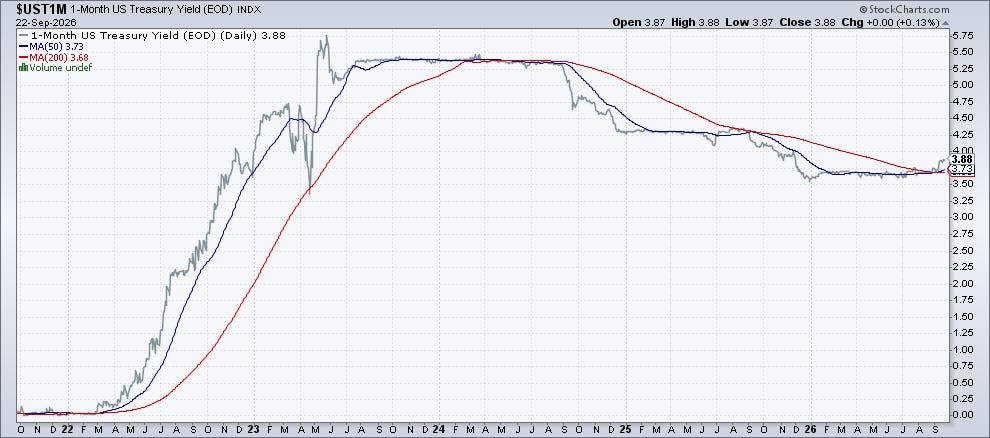
Taken together, the Fed Funds Model, fed funds futures pricing, and the behavior of Treasury yields continue to suggest a central bank that is not yet finished tightening. While last week’s quarter-point increase marked a shift toward less accommodative policy, financial conditions remain relatively supportive of economic growth and, by extension, inflation risk.
The key question now is whether incoming inflation data will show sufficient moderation to alter that outlook. If inflation pressures begin to ease decisively, market expectations for additional tightening could quickly retreat. At the moment, both policymakers and market-based indicators appear skeptical that inflation is on a sustainable path back toward the Fed’s target, based on PCE data.
A key takeaway may be not that the Fed has begun raising rates, but that policy still doesn’t appear restrictive. Despite the latest hike, TMC Research’s Fed Funds Model continues to indicate that monetary conditions remain modestly accommodative. Unless inflation slows more dramatically than current trends suggest, that assessment implies the Fed may have further work to do before policy reaches a genuinely neutral, let alone restrictive, stance.
