

By James Picerno | The Milwaukee Company
Significant intra-year declines are common, even in positive calendar years for stocks
Double‑digit drawdowns happen far more often than investors expect
Investors should prepare for “white-knuckle” volatility to avoid panic-selling at or near market bottoms
Managing expectations is one of the biggest investment challenges, especially as it relates to risk. Many stock market investors tend to underestimate the potential for short-term losses. That’s an oversight that threatens to derail an otherwise solid portfolio strategy if fear suddenly triggers a bout of selling at or near a market bottom.
The solution starts with developing reasonable assumptions about what’s possible, based on the market’s track record. A useful starting point is reviewing the history of drawdowns, which measure market corrections from the previous peaks. Even during bull markets, peak-to-trough declines can be relatively steep, a fact that may surprise investors.
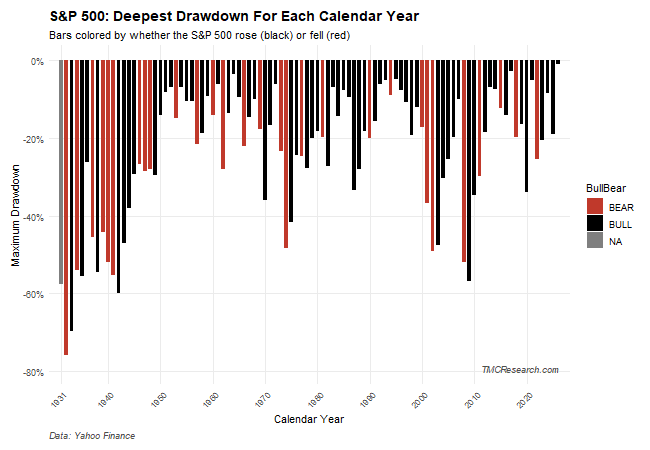
Some of the deepest drawdowns occurred in years when the S&P 500 Index rose during the calendar year, indicated by black bars in the chart below. Last year is an example: the market rallied more than 16% in 2025. A solid gain, but that didn’t prevent the market from enduring a steep intra-year drawdown of nearly -19%.
For a clearer summary of how the deepest drawdowns by calendar years compare through time, the boxplot below consolidates the historical results since 1931. The median is nearly -20% (black line). The interquartile range since is roughly -10% to -31% (shown in the box), which represents the most typical declines, statistically speaking.
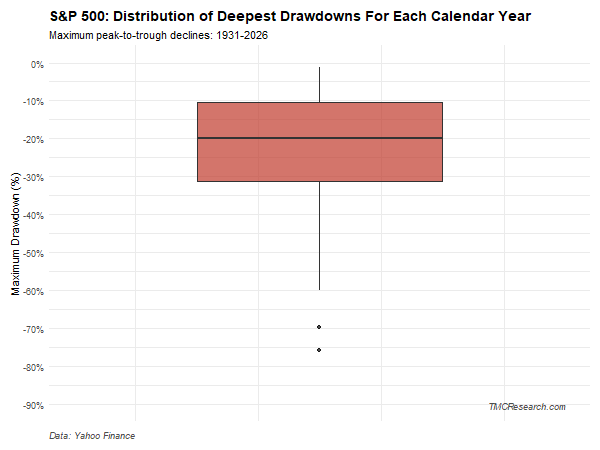
For the past 20 years, the interquartile range is a bit milder at -8% to -18%. But these drawdowns are still a reminder that a bull trend offers little, if any, immunity to sharp setbacks in the short term.
On that basis, what should we expect for 2026? More of the same is the baseline outlook, history advises. Since 2000, for example, most calendar years experienced at least one double-digit drawdown – only five calendar years beat the odds and posted a maximum drawdown no deeper than 8.5%.
The lesson is that a white-knuckle ride, even during a bull market, is a hardy perennial in the stock market. Preparing for these events, emotionally and otherwise, is essential to profit from equities in a meaningful degree over the long haul.
Meanwhile, the year is still young and the deepest drawdown so far in 2026 is a mere -1.1%. If history is a guide, we’re likely to see a much deeper shade of red at some point before the year is out, even if the bulls keep running.
