

By James Picerno | The Milwaukee Company
The yield curve’s recent false signal doesn’t mean it’s broken
Context matters: Yield-curve inversions are more informative when policy is tight and financial stress is rising
The yield curve still matters: Its shape influences bank lending and future economic activity
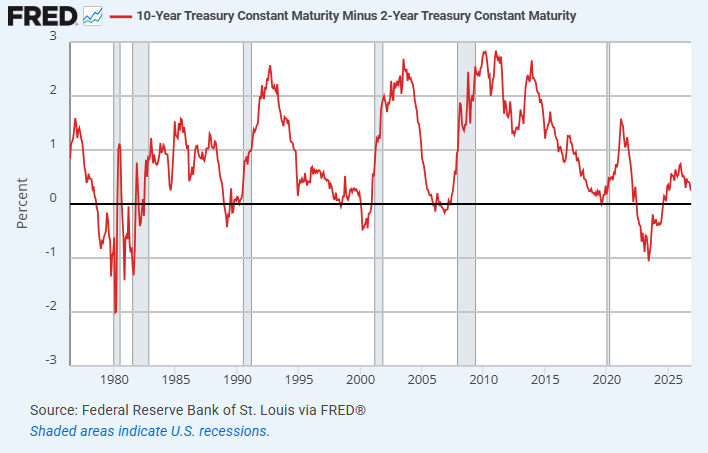
For decades, the yield curve has been one of the financial market’s most widely followed indicators of economic risk. When short-term Treasury yields rise above long-term yields, creating a yield-curve inversion, investors have traditionally viewed the signal as a warning that a recession may be approaching. That reputation was earned over time: inversions since 1980 preceded each of the last six U.S. recessions, making the yield curve one of Wall Street’s most closely watched forecasting tools.
The latest cycle, however, has challenged that track record. The yield curve inverted deeply for much of 2022-2024, yet the U.S. economy continued to expand, unemployment stayed relatively low, and the recession many economists anticipated never materialized. The episode sparked a broader debate: Has the yield curve lost its predictive power?
Recent research suggests the answer is no. But it does indicate that investors may need to rethink how they interpret the signal.
The Yield Curve Still Has Strong Academic Support
Despite recent skepticism, major Federal Reserve institutions continue to view the yield curve as a valuable forecasting tool. The New York Fed still maintains a recession-probability model based on the spread between 10-year and 3-month Treasury yields, even though its elevated recession forecasts for 2024-25 ultimately proved incorrect based on NBER business-cycle dating. The Cleveland Fed likewise continues to publish recession forecasts based on yield-curve measures while acknowledging that the 2022-2024 inversion joins a relatively short list of notable false positives.
In other words, the recent miss may not invalidate the indicator so much as highlight that no forecasting tool is infallible.
Looking Beyond a Single Indicator
Part of the challenge lies in deciding how to interpret this signal and understanding what drives yield-curve inversions in the first place.
Historically, inversions often emerged when the Federal Reserve raised short-term interest rates aggressively to cool an overheating economy. Such tightening frequently slowed growth enough to contribute to a recession. But recent research suggests that the broader macroeconomic context matters.
Researchers at the Boston Fed find that yield-curve inversions are most informative when monetary policy is restrictive. By contrast, when policy remains relatively accommodative, an inversion may overstate recession risk, underscoring the importance of understanding the forces driving the curve’s shape.
Analysts at Lazard, a money manager, made a similar observation in mid-2023, when the yield curve had been inverted for about a year while the economy continued to expand. “The team believes that the key issue holding back a recession has been the lack of a tightening in financial conditions that normally coincides with an aggressive Fed tightening cycle,” the authors wrote
Other research points to a similarly nuanced interpretation. A recent cross-country study found that the yield curve remains informative, but its forecasting power tends to improve when combined with measures of financial vulnerability, such as household and business debt burdens. The implication: an inversion may be more meaningful when accompanied by signs of financial stress.
A 2025 working paper from the Atlanta Fed reaches a similar conclusion from a different angle. The authors argue that the shape of the yield curve remains economically important because it influences bank profitability and lending activity. A steeper yield curve, particularly when driven by a higher term premium, tends to boost bank profits and support credit creation, which can influence future economic growth. In this view, the yield curve is not merely a statistical predictor but also a channel through which economic activity is transmitted.
Taken together, these studies suggest that the yield curve still matters, but it should not be treated as a standalone recession alarm, even though that approach appeared to work in the past.
The Better Question
The debate may ultimately come down to asking the right question.
Rather than asking whether the yield curve has lost its predictive power, investors may be better served asking whether it still works when interpreted in the context of modern market conditions, including quantitative easing, elevated government debt, shifting bank regulations, and changing global demand for Treasury securities.
The evidence increasingly suggests that it does.
The yield curve remains one of the most useful market-based indicators of future economic conditions. But the era when an inversion alone could be viewed as a high-confidence recession call may be over. Today’s environment requires a broader framework for analysis that considers the yield curve alongside monetary policy, credit conditions, debt burdens, and other measures of financial stress.
The yield curve isn’t dead, but it’s likely to work best when viewed as part of a larger mosaic of economic and financial indicators.
